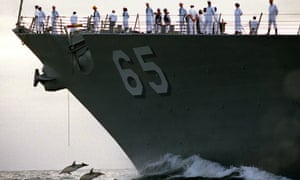
Low-frequency sonar used for training and testing can injure whales and other marine life, and disrupt their feeding and mating. Dolphins in front of US Navy ship Benfold. Marine life will now be protected from Navy sonar. Photograph: Mark Wilson/Reuters
The ninth circuit court of appeals reversed a lower court decision upholding approval granted in 2012 for the Navy to use low-frequency sonar for training, testing and routine operations.
The five-year approval covered peacetime operations in the Pacific, Atlantic and Indian Oceans and the Mediterranean Sea.
The appellate panel sent the matter back to the lower court for further proceedings. A message seeking comment from representatives of the US Pacific Fleet in Honolulu was not immediately returned.
The 2012 rules adopted by the National Marine Fisheries Service permitted Navy sonar use to affect about 30 whales and two dozen pinnipeds; marine mammals with front and rear flippers such as seals and sea lions, each year.
The Navy was required to shut down or delay sonar use if a marine mammal was detected near the ship. Loud sonar pulses also were banned near coastlines and in certain protected waters.
Environmental groups, led by the Natural Resources Defense Council, filed a lawsuit in San Francisco in 2012, arguing the approval violated the Marine Mammal Protection Act.
The appellate court ruled 3-0 that the approval rules failed to meet a section of the protection act requiring peacetime oceanic programs to have “the least practicable adverse impact on marine mammals”.
“We have every reason to believe that the Navy has been deliberate and thoughtful in its plans to follow NMFS guidelines and limit unnecessary harassment and harm to marine mammals,” the appellate ruling said.
However, the panel concluded the fisheries service “did not give adequate protection to areas of the world’s oceans flagged by its own experts as biologically important,” according to a summary accompanying the court’s decision.
“The result is that a meaningful proportion of the world’s marine mammal habitat is under-protected,” according to the decision.
"Black Lives do not matter to most black people...Only the lives that are taken at the hands of cops or white people, matter."
That is the conclusion of a strongly-worded post that has been shared more than 130,000 times on Facebook and has racked up hundreds of thousands of views on other media platforms such as Imgur.
While the sentiment is provocative, it is the identity of the author that triggered particular interest. Jay Stalien's profile indicates he is an active police officer in Florida and previously Baltimore. And he is black.
The post was published last weekend, amid mounting racial tensions across America following the murder of five Dallas officers at a protest held over the police killings of two African-American men in Minnesota and Louisiana. Stalien, who says he is a Brooklyn native, was particularly scathing about Black Lives Matter, questioning whether the lives of police officers (including ones who are African-American) were as important to the movement, as black civilians killed by white police officers.
"I couldn't help but wonder if it had been me, a black man, a black cop, on TV, assassinated, laying on the ground dead...would my friends and family still think black lives mattered? Would my life have mattered?" Stalien wrote.
While the official Black Lives Matter Twitter account published a post shortly after the Dallas killings, saying that it did not condone violence towards anybody, Stalien's post certainly resonated with a large portion of social media users - many of them supporters of the Blue Lives Matter movement.
Image copyrightTWITTER
In his lengthy digital essay Stalien challenged assertions that black people are unfairly penalised by law enforcement. It was his arguments about black-on-black violence that seemed to get the most attention. Drawing on his own experience, Stalien said he chose a career in law enforcement because:
"I watched and lived through the crime that took place in the hood. My own black people killing others over nothing. Crack heads and heroin addicts lined the lobby of my building as I shuffled around them to make my way to our 1 bedroom apartment with 6 of us living inside. I wanted to help my community and stop watching the blood of African Americans spilled on the street at the hands of a fellow black man."
But Stalien expressed his frustration that his efforts to investigate black-on-black violence and bring the culprits to justice had met with outright hostility from the very community he sought to protect.
"They called me 'Uncle Tom', and 'wanna be white boy', and I couldn't understand why," he wrote.
"My own fellow black men and women attacking me, wishing for my death, wishing for the death of my family. I was so confused, so torn, I couldn't understand why my own black people would turn against me, when every time they called …I was there. Every time someone died….I was there. Every time they were going through one of the worst moments in their lives…I was there. So why was I the enemy?"
Stalien, said that in an attempt to answer that question he looked into some of the most common complaints levelled at police by activists, to see if there was a statistical basis for these grievances. Much of his article is taken up by a point-by point presentation of the results of that research, which Stalien uses to assert that many of the gripes of the Black Lives Matter movement are unfounded.
As this is an area where the use of statistics is particularly contentious, Trending sought a second opinion on some of the Stalien's statistical claims. We spoke withPhilip Stinson, associate professor of criminal justice at Bowling Green State University in Ohio. So here are a couple of the common complaints which Stalien sets up in his article and then knocks down, followed by Stinson's take on that rebuttal.
Activist complaint 1: "Police always targeting us, they always messing with the black man."
Officer Stalien's view:
"A city where the majority of citizens are black (Baltimore for example) …will ALWAYS have a higher rate of black people getting arrested, it will ALWAYS have a higher rate of blacks getting stopped, and will ALWAYS have a higher rate of blacks getting killed, and the reason why is because a city with those characteristics will ALWAYS have a higher rate of blacks committing crime. The statistics will follow the same trend for Asians if you go to China, for Hispanics if you go to Puerto Rico, for whites if you go to Russia, and the list goes on. It's called Demographics"
Dr Stinson's response:
"I don't agree with his logic. There certainly is implicit bias in many police street encounters with black males. Many police officers in the United States view blacks in these encounters as a threat. Similarly, many of the blacks in these street encounters with police officers are afraid of the police. There are good points to be made on all sides of this issue."
Image copyrightSCOTT OLSON
Activist complaint 2: "Blacks are the only ones getting killed by police, or they are killed more."
Officer Stalien's view:
"Fact: As of July 2016, the breakdown of the number of US Citizens killed by Police this year is, 238 White people killed, 123 Black people killed, 79 Hispanics, 69 other/or unknown race."
Dr Stinson's response:
"Blacks are shot and killed by on-duty police officers at a HIGHER RATE than are white persons. In other words, it is misleading to look at the raw numbers without adjusting for population differences."
This view was echoed by analysis published by Quartz magazine which concluded that while raw data from 2015 showed that "police have indeed killed nearly twice as many white as black Americans", when you "look at those killings as a share of each ethnic group's population, it's a very different story: black people are at three times as high a risk of dying at the hands of police as white people."
Officer Stalien's view:
"Fact: Black people kill more other blacks than Police do, and there are only protest and outrage when a cop kills a black man. University of Toledo criminologist Dr. Richard R. Johnson examined the latest crime data from the FBI's Supplementary Homicide Reports and Centers for Disease Control and found that an average of 4,472 black men were killed by other black men annually between Jan. 1, 2009, and Dec. 31, 2012. Professor Johnson's research further concluded that 112 black men died from both justified and unjustified police-involved killings annually during this same period.
Dr Stinson's response:
"These numbers are wrong to the extent that the data relied upon are incomplete and inaccurate. Both the Supplemental Homicide Reports and the CDC data sets underreported. We know that, in part, from the Washington Post numbers for 2015 and 2016. But, we do not know if the error and bias in the underreported data in the FBI and/or CDC is systematic or random. As such, I would not use either data set to draw statistically significant conclusions," adds Stinson.
Whatever your take on the data, many found Stalien's post to be a powerful testimony about the complexities of life as a black police officer in the US.
At a memorial service for the slain five police officers at Meyerson Symphony Center in Dallas, he said "When anyone paints all police as biased or bigoted, we undermine those officers we depend on for our safety."
Then he added, "America, we know the bias remains. We simply cannot turn away and dismiss those in peaceful protest as troublemakers and paranoid. To have your experience denied like that, dismissed by those in authority, it hurts."
Chris Froome's extraordinary run up Mont Ventoux in the yellow jersey will go down in Tour de France history.
The defending champion legged it for just under a kilometre after his bike was broken in a collision with two other riders.
Even though Belgian Thomas de Gendt won the stage on the lower slopes of one of the tour's most iconic climbs, Froome was reinstated at the top of the leader board. The Briton's steely determination on his unexpected hill run has inspired online admiration and humour.
Some on social media have suggested Froome could give Usain Bolt a run for his money.
Image copyrightTWITTER/DOCTORMIARMA
Or show a clean pair of heels to the bulls running at Pamplona.
Image copyrightNOAH SEELAM/GETTYImage captionA nurse administers a diphtheria vaccination in Kerala
Of all the heartbreaking challenges in life, a preventable death must be somewhere up there at the top for tragedies. Especially if it's that of a child.
But when Muhammad Niyas, a doctor in Kerala, wrote a Facebook post about the "totally preventable" death of a 14-year-old boy in his care, it revealed more than an isolated case and shed a light on an alarming health problem in the South Indian state.
Muhammad Niyas a doctor at Calicut Medical College in Kerala, says he is no stranger to death. "I have seen deaths to such an extent that I often wonder if I feel death any more," he wrote in the viral post. But when a teenage boy with a sore throat came under his care, it would become a night that Dr Niyas said would stay with him for the rest of his life.
The boy was battling diphtheria, the highly contagious bacterial disease that was once-eradicated in India, but has seen a recent resurgence in several Indian states.
"I can't describe the agony on his face as he battled death. I cursed all the vaccine hate mongers in Kerala a 1000 times in my mind as I was looking at him, my helplessness hid behind my (surgical) face mask," Dr Niyas wrote.
Image copyrightFACEBOOK
Dr Niyas told Trending that the boy "succumbed to his illness because the procedure was so serious that our treatment was not working...I was very angry because diphtheria is a totally vaccine preventable disease."
A number of people, several of them health officials, commented on Dr Niyas' post, clearly sharing his frustration on anti-vaccination.
Image copyrightFACEBOOK
In Kerala there have been two deaths from the disease and more than 30 confirmed cases since May this year - the highest ever in the state's history. Kerala's Chief Minister Pinarayi Vijayan appealed to people to come together to fight "a campaign that has been launched by a section of society against vaccination drives."
Image copyrightFACEBOOKImage captionDr Niyas says that an "anti-vaccine mafia" of lobbyists are responsible for Kerala's diptheria outbreak
But who is this section of society? Dr Niyas calls them the "anti-vaccine mafia". He told Trending that "it was their activities, their organised activities in Kerala that has caused the death of this child."
NDTV reported that a Muslim dominated area in north Kerala, Malappuram, had seen "strong anti-vaccination propaganda". The TV channel reported that rumours had been spread that a conspiracy to control or even harm the Muslim population was being initiated through administered vaccinations.
Dr Ummer Farooq - a senior public health official in Malappuram- agreed. He told Trending that anti-vaccination leaflets were being handed out and public gatherings were taking place in parts of the state to discourage immunisation.
But who are the people organising this?
"When we enquired about them, they were fake homeopathy doctors or naturopaths," he said. "They call themselves 'doctors', but when we enquired about their qualifications - they aren't real doctors. They hold public demonstrates, and create misunderstanding using WhatsApp groups. It was a public anti-vaccination propaganda campaign. To some, they said these medicines were made by Americans to curb the Muslim population. And to others they said the vaccines contain harmful chemicals."
Image copyrightFACEBOOKImage captionMemes suggesting that "vaccines cause cancer" are used on some homeopathy sites
However, he added that it was naive to assume that this was a Muslim issue. Dr Farooq and Kerala's health minister have named, Jacob Vadakkancherry (who is a Christian) and runs a private "natural hospital" in Kerala, as spreading a lot of anti-vaccine sentiments via Facebook.
Vadakkancherry's hospital has more than 20,000 likes on Facebook, and in videos posted there, he says harmful chemicals used to preserve dead bodies in hospitals, are being added to vaccines. Some posts cite studies (which we can not verify) that say vaccines cause cancer and memes which say kids who have not been immunised get sick less often.
Trending spoke to Vadakkancherry - and he declined to be interviewed for our radio programme. But he told us that he was not totally opposed to vaccinations, however he wasn't sure how safe they were. He said he simply wanted health workers who carry out vaccinations to get the informed consent of patients and to guarantee compensation if somebody experienced side effects.
Even though Kerala has been said to generally have excellent healthcare standards, matching those of Western countries, the Times of India say that more than 50,000 children in the state have not taken the complete doses of preventive vaccination in their childhood. Kerala's health department have since launched a drive to bring diphtheria under control.
Scores of people have been killed in Turkey and more than 1,400 wounded as a result of an attempted coup overnight. But who was responsible, what happened and why?
How did it start?
Bridges over the Bosphorus strait in Istanbul were blocked by troops late evening local time on Friday. Fighter jets and helicopters were seen flying over the Turkish capital, Ankara, and gunshots heard.
Soon after, Prime Minister Binali Yildirim announced that an attempt to overthrow the government was underway.
A faction of the army then said, via a state broadcaster, that it had seized power to protect democracy from President Recep Tayyip Erdogan.
Image copyrightAFPImage captionSupporters of Mr Erdogan took to the streets as the night developed
A curfew, martial law and the preparation of a new constitution was announced. In response Mr Erdogan called on his supporters to take to the streets in protest and returned to Ankara from a holiday resort.
Over the course of a violent night, TV stations were raided by soldiers, explosions heard in Istanbul and Ankara, protesters shot at, the parliament and presidential buildings fired upon, a military helicopter shot down and the Turkish military chief taken hostage.
How did it end?
In the early hours of Saturday morning, groups of soldiers involved began to surrender. Troops abandoned their tanks with their hands up.
Image copyrightGETTY IMAGESImage captionSoldiers abandoned weapons and clothes as they surrendered
Security forces also took back key installations and bases, including the military headquarters. By noon local time, Turkey's EU minister Omer Celik said the situation was "90 percent under control".
It remains unclear, but the government has blamed Fethullah Gulen, a powerful, reclusive US-based Muslim cleric whom it accuses of fomenting unrest. Mr Gulen denied the claims and has condemned the coup.
Turkish media have suggested two men may have orchestrated the putsch: General Akin Ozturk, the former commander of the Turkish Air Force, and Lieutenant-General Metin Iyidil, a commander with the Land Forces Training and Doctrine Command.
Image copyrightGETTY IMAGESImage captionAlmost 3,000 soldiers have been arrested
In any case, nearly 3,000 alleged coup backers have been detained, including high-ranking officers. Some soldiers have claimed to have been told they were taking part in military exercises and did not know a coup was being attempted, media reports say.
President Erdogan has also dismissed some 2,745 judges in the wake of the coup.
Why would they have done it?
The Turkish army has historically intervened in politics as it sees itself as the protector of Turkey's secularism and democracy.
It has had tensions with Mr Erdogan's AKP party over its political Islamism. The president has also cracked down on free media and is seen as an authoritarian by many people.
BBC Middle East Editor Jeremy Bowen also suggests the war in neighbouring Syria and its spill over effects on Turkey, including jihadist attacks, may have been a factor.
What has the response been outside Turkey?
US President Barack Obama called on Turks to support their elected government, while European Council President Donald Tusk and called for a "swift return to Turkey's constitutional order".
The Nato military alliance, of which Turkey is a member, called for "full respect" for Turkey's democratic institutions.
Russia said the situation was a threat to regional stability, while Iran said the events showed a "coup d'etat has no place" in the region.
The British Foreign Office advises that visitors stay indoors and avoid public places, especially where protests are occurring.
Many flights in and out of Turkey have been cancelled, including those on British Airways. Turkish Airlines say they have restarted flights at Istanbul's Ataturk Airport. If you have travel plans involving Turkey, check with your airline.